From 2012 to 2020, Fr. Paul Mankowski, SJ delivered hundreds of lectures and master classes at the Lumen Christi Institute. Seeking to share the depth of his scholarship, this podcast offers many of his lectures (edited for coherence and quality) to the public in digital format for the first time.
The first season features a course that Fr. Mankowski gave on Joseph Ratzinger’s Jesus of Nazareth, and dozens of lectures centered around the books of the Bible (including Genesis, many of the prophets, the Gospel of Matthew, and St. Paul’s Letter to the Romans). Two interviews with people who knew Fr. Mankowski well and can offer an entry point to his person and scholarship conclude the season.
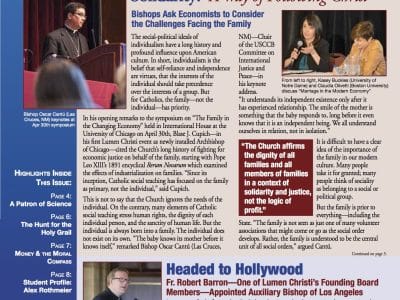
The social-political ideals of individualism have a long history and profound influence upon American culture. But for Catholics, the family—not the individual—has priority.
The Scientific Revolution that took place in the 17th century and gave birth to modern science did not develop in opposition to revealed religion argued Stephen M. Barr—Professor in the Department of Physics and Astronomy and Director of the Bartol Research
Jim Perry, Managing Director of the private equity firm Madison Dearborn Partners, discusses being a business leader who takes the social teaching of the Church seriously with Booth students.
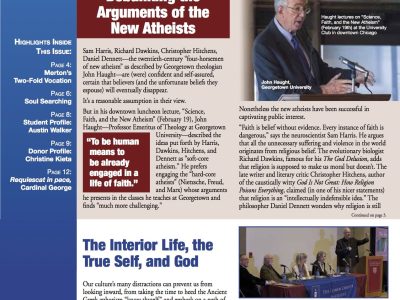
Georgetown theologian John Haught addresses the arguments and thought of the so-called "new atheists:" Sam Harris, Richard Dawkins, Christopher Hitchens, Daniel Dennett.
Gary A. Anderson (University of Notre Dame; author of Charity: The Place of the Poor in the Biblical Tradition) It has long been acknowledged that Jews and Christians distinguished themselves through charity to the poor. Though ancient Greeks and Romans
Jean-Luc Marion (University of Chicago) cosponsored by the Philosophy Department How is it possible to admit a rational truth that at the same moment could not be achieved by mere rationality? This implies a revision of the definition of knowing,
How does today’s economy impact the modern family? Several trends link mounting burdens on family life to economics: children are raised amid familial and fiscal instability, young people are delaying or forgoing marriage, the elderly are made increasingly vulnerable with
Giuseppe Mazzotta (Yale University) Keynote Lecture for the Graduate Student Conference on “Amor Vincit Omnia: Love as a Destructive Force in Italian Arts and Literature” Sponsored by: The Franke Institute for the Humanities, the Norman Waite Harris Fund, the Istituto