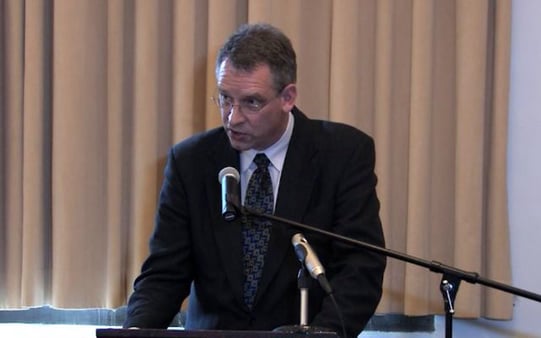
Prof. Corey Barnes (Oberlin College) led a seminar on Aquinas’s Christology in his Summa theologiae at the University of St. Mary of the Lake Conference Center in Mundelein, Illinois.
Deeply ingrained assumptions about the nature of historical change prevent an adequate comprehension of the transformations that have created the contemporary Western world over the past half-millennium. Departures from traditional Christianity since the sixteenth century, and related attempts to ground truth claims in scripture or reason alone yielded unintended pluralisms via Protestantism and modern philosophy that remain pervasively influential today. Catholicism continues to offer an intellectually viable alternative–provided one does not subscribe to inadequate views of how the past became the present. You can subscribe to the Lumen Christi Institute Podcast via our Soundcloud page, iTunes channel, or by searching for our...
Thomas Aquinas’s doctrine of the Trinity is crucial to James Joyce’s presentation of the artist in both Portrait of the Artist and Ulysses. Now, Joyce’s deployment of Trinitarian themes is not strictly orthodox of course. But the Trinity does provide a model, an exemplar, for a proper understanding of artistic fecundity and a subtle critique of popular romantic conceptions of artistic self-expression. Whatever his intentions, Joyce’s treatment suggest ways in which the Thomistic doctrine of the Trinity and the Imago Dei can contribute to a fresh understanding of artistic activity.
This conference addresses the following questions: What constitutes the image of God? How are we to understand Augustine’s claim that human beings come to understand both who they are and who they have been only through relationship with God? How do St. Thomas Aquinas and Blaise Pascal remain within or depart from the Augustinian tradition? What role do Aristotelian and Platonic (or neo-Platonic) conceptions of human identity and the soul play? Lastly, as Genesis offers an essentially relational account of “Imago Dei,” in what way can we discover or participate in such relationship with God through social relationships?
The broad public debates on religion and ethics frequently suffer from empirical deficiencies. All sides tend to argue in a way one might call an “a priori” mode of argumentation. In contrast, this lecture offers some empirically grounded reflections. First, Hans Joas asks whether the morality of secularized societies could be a mere remnant or reverberation of religious traditions. Secondly, he briefly investigates with regard to tribal societies whether religion should be considered to be constitutive for morality at all. Thirdly, he uses an example from Christian missionary work to look at the interaction of new religion and traditional morality....
American Catholic women rarely surface as protagonists in histories of the United States. Offering a new perspective, Kathleen Sprows Cummings places Catholic women at the forefront of two defining developments of the Progressive Era: the emergence of the “New Woman” and Catholics’ struggle to define their place in American culture. Cummings highlights four women: Chicago-based journalist Margaret Buchanan Sullivan; Sister Julia McGroarty, SND, founder of Trinity College in Washington, D.C., one of the first Catholic women’s colleges; Philadelphia educator Sister Assisium McEvoy, SSJ; and Katherine Eleanor Conway, a Boston editor, public figure, and antisuffragist. Cummings uses each woman’s story to...
Published in 1949, Paul Blanshard’s American Freedom and Catholic Power captured the attention of American intelligentsia with its claim that American Catholic citizens had to choose “between a church hostile to fundamentals of democracy and a state where contrary views are implicit under our Constitution.” John F. Kennedy’s famous speech to Protestant ministers in Houston on Sept. 12, 1960 was in many respects a response to Blanshard’s thesis. Today Blanshard’s bigotry may not be explicitly defended in educated circles, but questions remain about what made his book so compelling. Patrick Brennan considers whether Blanshard was onto something about the incompatibility of Catholic...
David Nirenberg (University of Chicago) Cosponsored by the Chicago Center for Jewish Studies
In Sin: A History, Gary Anderson shows how changing conceptions of sin lay at the heart of the biblical tradition. Spanning two thousand years, the book demonstrates how sin, once conceived of as a physical burden, becomes, over time, eclipsed by economic metaphors. Transformed from a weight that an individual carried, this Jewish revolution in thought shaped the way the Christian church understood the death and resurrection of Jesus.
Cosponsored by the Center for Law, Philosophy and Human Values This lecture considers several recent attempts by Catholic political philosophers working in the natural law tradition to give an account of law’s authority, and their success in answering some recent criticism. The difficulties in providing a successful natural law account of law’s authority gives us reason to rethink the sort of explanatory ambitions of new natural law theorists.
Gyula Klima (Fordham University)