
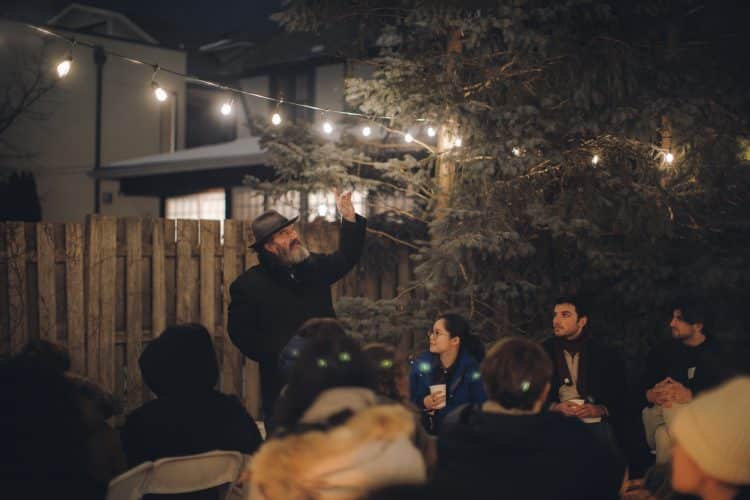
On a frigid night in early February, the backyard of Gavin House is sprinkled with snow and filled with students. Despite the bite in the air there is an undeniable warmth to the darkness. Firepits crackle and flicker on smiling faces and fingers wrap snugly around mugs of hot chocolate. One friend leans over to make a laughing aside to another. A low hum of voices fills a space whose walls are trees, fence, and the limit of the firelight’s strength. A bearded man stands before them, with a mien at first gruff, but then you see the twinkling eyes and the wry smile tugging at the edge of his mouth. He lifts his hands and a hush falls. For a split second there is silent anticipation and the sound of measured breathing. And then,
It is said and said truly of the hero Fionn mac Cumhaill that if a day goes by without his name being mentioned the world as we know it will come to an end.
Dr. Martin Shaw is a mythologist and storyteller. As a mythologist, Shaw studies and teaches ancient stories, especially of his own place and people: the Irish, for his roots, and the small westerly region of England whence he hails. In a way, mythology is like any other academic discipline, requiring advanced graduate training with the tools proper to its field. But a true mythologist, Shaw explains, cannot care only for theory and nothing for the magic of the story–that would be to lose in study the heart of the very thing you study.
This is why during his week-long visit to Chicago in February, Shaw concluded his conversational lectures on the theory of mythopoetics and faerie stories with a spellbinding retelling of the Irish tale, “The Birth of Ossian.”
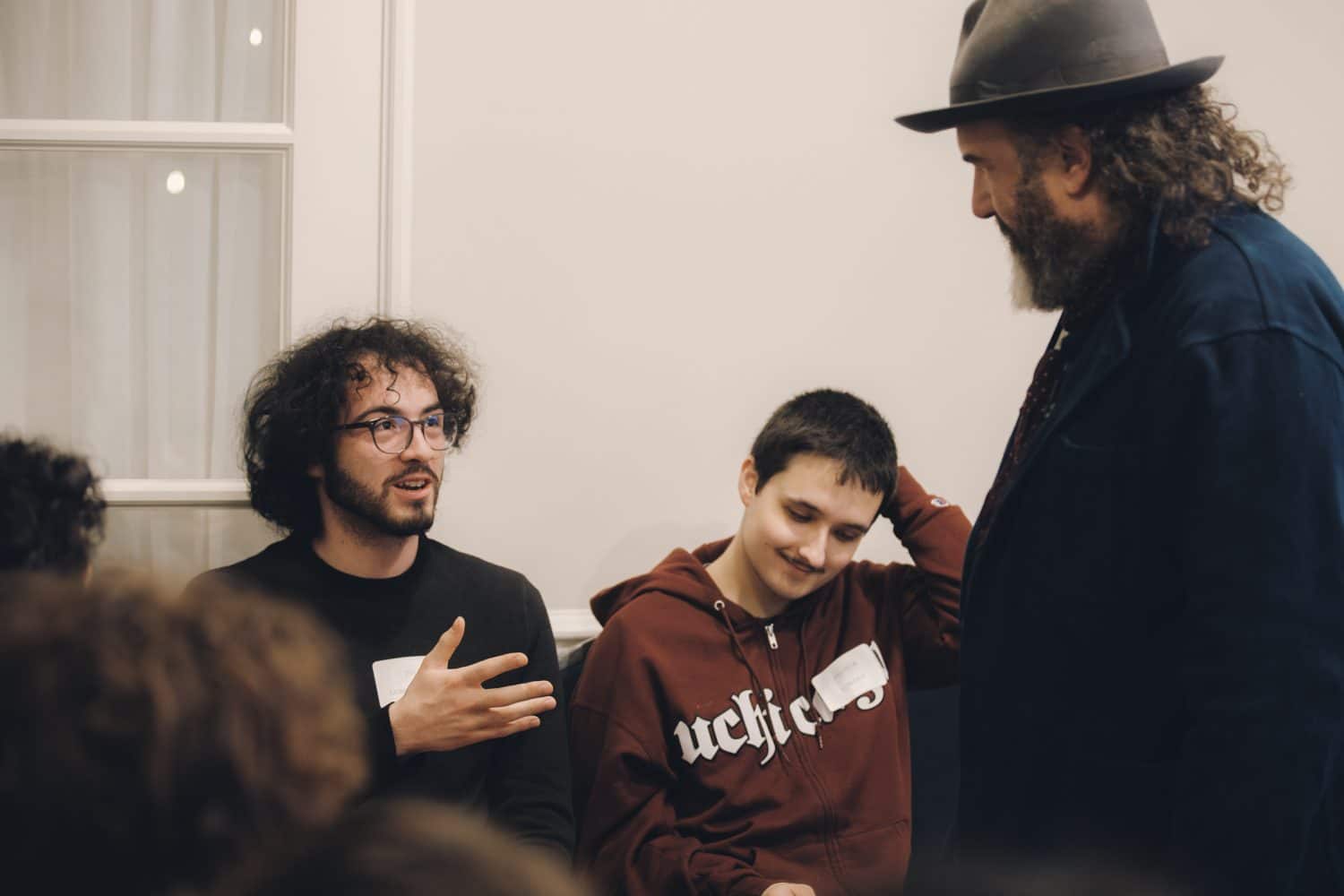
For Shaw, stories are a basic human need because humans are meaning-seeking creatures. We are intelligent, which means both that we seek truth and we make sense of our lives and our world through narratives, or stories. Our faith, after all, rests on a story more fantastic than any myth: a chosen people questing through millennia, pillars of fire, a virgin birth, angelic messengers, and dead men walking. “The Christian myth is the one with the strangest God of all,” Shaw remarks, “the one with a dog in the race; who throws himself into the madness.”
Learning how to enjoy a myth helps cultivate a distinctly Christian attitude: one of receptivity and wonder towards that which exceeds, transports, and sometimes troubles or overwhelms. Myths can be encountered but not conquered; formed by a whole people and with no single author. The meaning may touch us but always eludes mastery. To truly love and learn from myths, Shaw insists, like the Questing Beast of Arthurian legend, one must ever trail but never trap the ancient stories of one’s people. Once you trap it, you have a pelt, not a wild animal.
These transcendent stories are of gravest importance in the moments of greatest pain and difficulty, when facts break down. “Some things,” Shaw explains, “are too big for facts. You need poetry.” Poetry–not simply rhymes and meters but the flight of the soul–is what you will need when the world bewilders you, when your heart has been broken. We are in a time ripe for myth, because everywhere we see turmoil, unpleasantness, wildness writ large. “Myths always begin when we are outnumbered and utterly bewildered,” Shaw explains.
‘Myth’ nowadays is a word we use to belittle something that is not true or need not be taken seriously. Instead, Shaw says we should think of a myth as a sacred story that we receive through the hands of our ancestors. A real myth is not selling you something, not trying to convince you that you could be better if you do x, y, or z. A real myth is troubling, difficult. It is never a neat story.

Yet myths do offer important insights about how we came to be the way we are. All cultures have a poetic explanation of origin, which tells a great deal about that culture. We can see this in studying the Hebrew scriptures, the stories of God’s loving creation and slow revelation. Myths of many cultures are of value to the Christian because, as St. Augustine tells us, all truth is God’s truth. Or in Shaw’s words, “Many myths and stories have pinpricks of eternity in them.”
Shaw’s most recent book Liturgies of the Wild: Myths that Make Us is published by Penguin Random House.