

For sixteen centuries, St. Augustine of Hippo has shaped Christian tradition. Augustine is known for his keen theological insight and lyrical prose, as manifested particularly in his much-loved Confessions. Augustine is considered the father of Western theology, but his impact extends beyond Christian thought. He has also formed the daily living of the faith and the structure of the Church: The Rule of St. Augustine is one of the earliest documents outlining the shape of what we now call religious life.
St. Augustine’s legacy took on a renewed meaning with the election of Pope Leo XIV in May. In his first address as pope, Leo declared himself “a son of St. Augustine.” With these words, Leo announced a direction for his papacy which would take its inspiration from this fifth century theologian, who wrote to his people, “I am a bishop for you, and a Christian with you.”
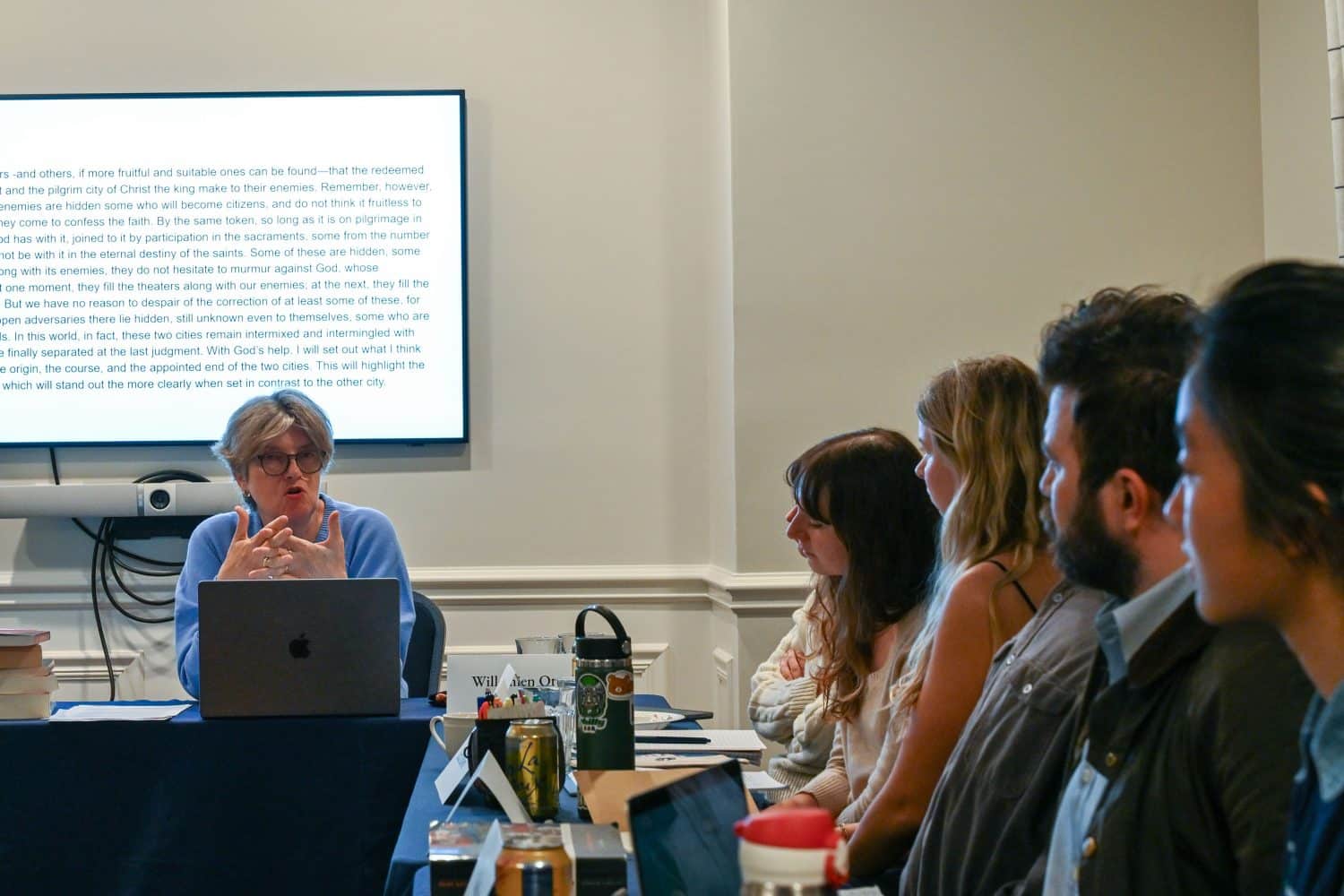
Following the Holy Father’s lead, the Lumen Christi Institute dedicated the fall non-credit course to an intensive study of the thought of St. Augustine. LCI holds a non-credit course each quarter to provide an opportunity for students from the University of Chicago to pursue intellectual questions freed from the constraints imposed by ordinary course requirements. One of the most important freedoms gained in this format is that students are able to integrate their academic interests with the questions that most weigh on all of us: questions of ultimate meaning, human destiny, and the purpose of existence.
It was precisely this question of meaning and the secular academy’s inability to provide satisfying answers which led Cassandra Sever to study St. Augustine. Sever is a sociologist and one of the first two Postdoctoral Fellows in Catholic Studies with the Lumen Christi Institute. She credits her return to the faith during her graduate studies to the North African doctor of the Church.
Sociology aims to explain the human person and human action in society from a purely material vantage point. Sever was drawn to the study of sociology by a desire to understand the self, but the more she studied the more frustrated she became. The discipline is committed to a view of the human person that is morally neutral and views human beings as fundamentally self-creating and self-determining. It asserts that there is no immoveable gravitational center for human identity.
This answer was not satisfying for Sever: “Nothing I read seemed to understand the most significant parts of life.” She went in search of a better explanation and it was then she found Augustine. “His theology is what my anthropology is founded in. His work showed me that the human person is grounded in a search for goodness. He is the hinge to how I see everything.”
As Sever explains, “I would ask my students, ‘Do you really think people behave the way they do because of materialism? Is that truly how you have encountered others?’ The answer was always no. Augustine’s anthropology helped me understand that there is a satisfying explanation: people crave meaning.
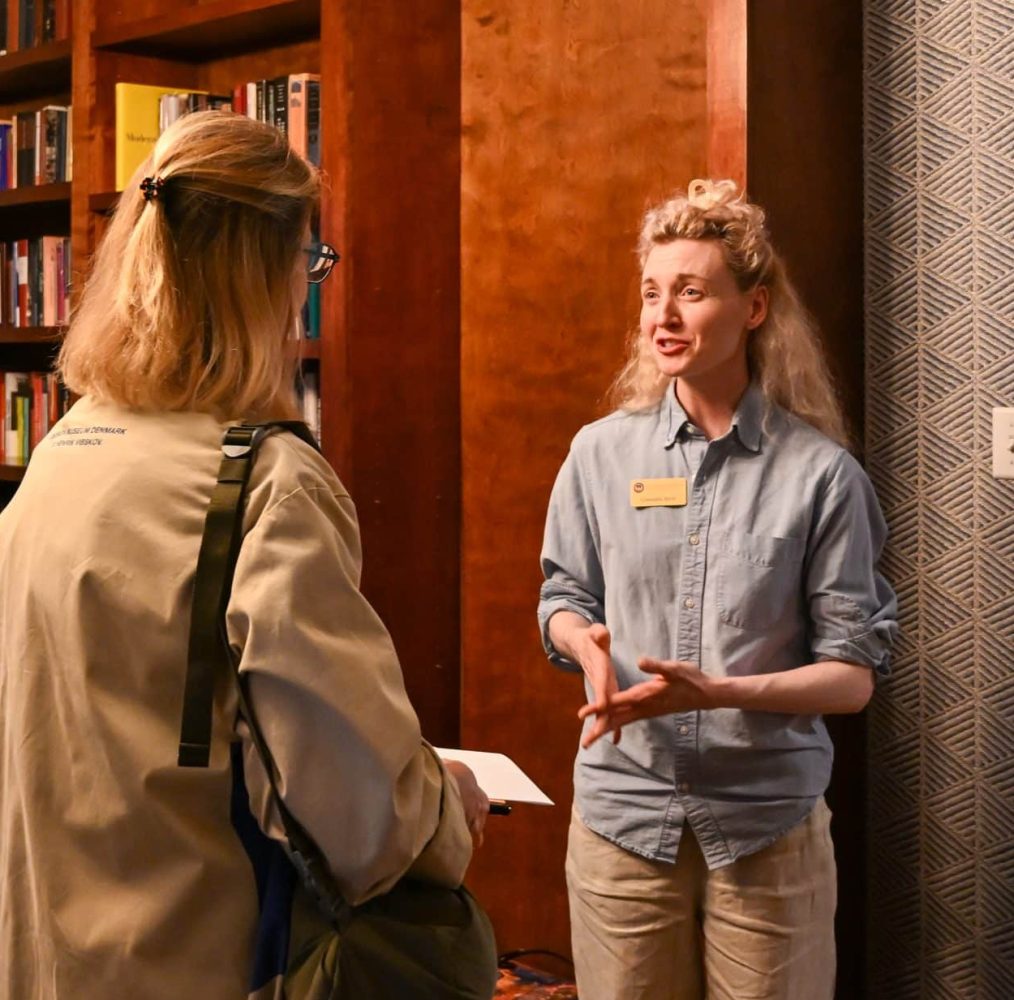
“It’s because human beings are oriented toward meaning that I can study despair,” Sever continues. “I can’t study ultimate meaning itself, which lies beyond our full grasp as human persons, but I can study despair –the condition that arises when our search for meaning becomes disordered.”
Sever began incorporating Augustine into her research by investigating social problems from an Augustinian perspective. Ironically, this perspective led her to study despair.
“I looked at examples of nostalgia for totalitarian regimes and political extremism. I found in each case that the people shared a collective despair.” Sever believes this is the beginning of a breakthrough for sociology, which still premises its explanation on shared materialism. Though scholars realize this explanation is not sufficient, a better explanation has not yet been articulated. It is in this space that Sever aims to make her contribution.
The coincidence of Leo XIV’s core themes for his papacy and Sever’s research made her selection for the postdoctoral fellowship earlier in the spring fortuitous. Her research at LCI will further the institute’s commitment to following Leo’s lead in rediscovering what St. Augustine has to offer the twenty-first century Church.
Sever taught one of the sessions for the non-credit course in November, focusing on Augustine and the sociology of the self. Modeling how Augustine’s thought can be applied beyond an intramural, theological appreciation was one of her priorities.
“I want to show how Augustine’s thought can be integrated into sociology and ask questions about what Augustine would say about today’s social crises. If sociology has the right metaphysical foundation, it has an immense capacity to show us truths about ourselves.”
This integration of the secular academy and Catholic faith is what drew Sever to the Lumen Christi Institute.
“I found out about Lumen Christi’s postdoc positions just two days before they were due. I was teaching at a secular university and felt starved for community as a Catholic scholar. When I read the description, I thought, ‘joining secular disciplines to the Catholic Tradition, that’s me!’ I wanted to work and live in a place where the Catholic intellectual tradition was active.”
In the few short months that Sever has been with the institute thus far, she says confidently that she found what she was looking for.
“I love being part of a genuine Catholic intellectual community. I have spent most of my career with my moral and metaphysical questions needing to remain implicit when I talk to my colleagues. Here I have found colleagues who understand and share these questions. They know that the search for objective truth is the ultimate goal. That has been very lifegiving for me as a scholar.”