
The Solzhenitzyn Question
Aleksandr Solzhenitsyn left a vast body of work, an inestimable influence on Russian culture, and a deeply divided public opinion. He documented the Soviet prison system, developed forms of literary representation for describing the experiences of prisoners, and was courageous in the face of repression. But doubts linger about him as artist, thinker and person, and thus prompt us to raise the Solzhenitsyn question.
Thomas Aquinas, Scientist: How Might He Approach 21st Century Biotechnology
Despite flaws in his biology, Aquinas’ writings offer us guidance in our approach to 21st century biotechnology. Aquinas’ notion of a Just War provides us with a way for thinking about biotechnology, since both use morally ambiguous means to address evils in an imperfect world. A comparison of these two disparate issues can yield criteria for an ethics of biotechnology.
Against Nostalgia: Catholicism, History and Modernity
Deeply ingrained assumptions about the nature of historical change prevent an adequate comprehension of the transformations that have created the contemporary Western world over the past half-millennium. Departures from traditional Christianity since the sixteenth century, and related attempts to ground truth claims in scripture or reason alone yielded unintended pluralisms via Protestantism and modern philosophy that remain pervasively influential today. Catholicism continues to offer an intellectually viable alternative–provided one does not subscribe to inadequate views of how the past became the present. You can subscribe to the Lumen Christi Institute Podcast via our Soundcloud page, iTunes channel, or by searching for our…
The Authority of Law in Recent Catholic Political Philosophy
Cosponsored by the Center for Law, Philosophy and Human Values This lecture considers several recent attempts by Catholic political philosophers working in the natural law tradition to give an account of law’s authority, and their success in answering some recent criticism. The difficulties in providing a successful natural law account of law’s authority gives us reason to rethink the sort of explanatory ambitions of new natural law theorists.
Are Catholics Unreliable from a Democratic Point of View? Reflections on the 60th Anniversary of Paul Blanchard’s American Freedom and Catholic Power
Published in 1949, Paul Blanshard’s American Freedom and Catholic Power captured the attention of American intelligentsia with its claim that American Catholic citizens had to choose “between a church hostile to fundamentals of democracy and a state where contrary views are implicit under our Constitution.” John F. Kennedy’s famous speech to Protestant ministers in Houston on Sept. 12, 1960 was in many respects a response to Blanshard’s thesis. Today Blanshard’s bigotry may not be explicitly defended in educated circles, but questions remain about what made his book so compelling. Patrick Brennan considers whether Blanshard was onto something about the incompatibility of Catholic…
Symposium on Caritas in Veritate
Published upon the heels of the global financial collapse of 2008, Benedict XVI’s social encyclical, Caritas in Veritate, has been received with great controversy in America. Conservatives have criticized the encyclical’s indictment of neoliberal policies while progressives have severed the encyclical’s social concerns from their origin in the sanctity of human life. This panel discussion of Caritas in Veritate will consider the encyclical in light of the tradition of Catholic social teaching, the political difficulties facing economic reform, and the challenge of inter-religious dialogue.
Representation vs. Direct Realism in Modern Philosophy
Gyula Klima (Fordham University)
Spiritual Exercises and the Contemporary Academy
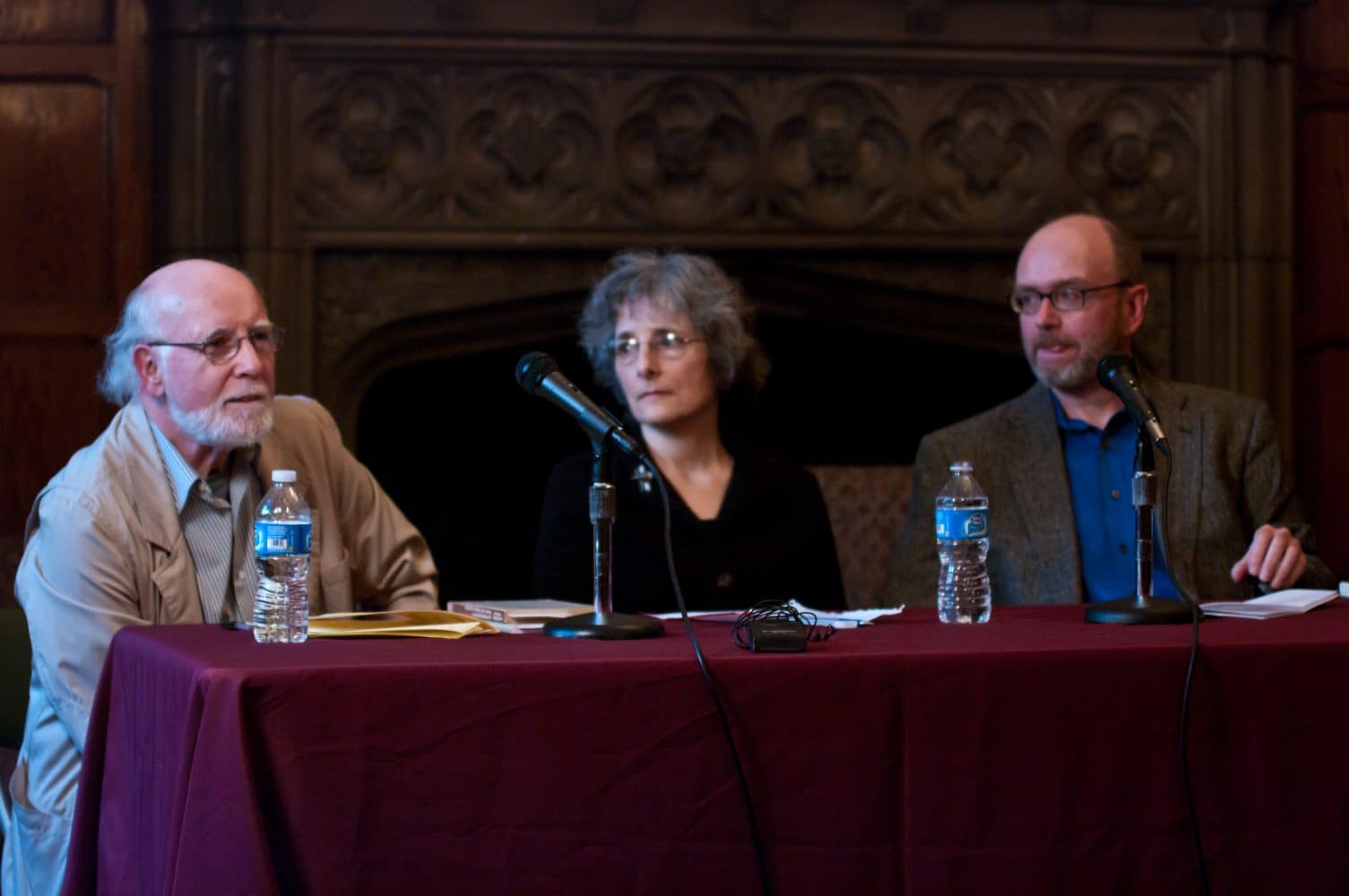
The work of Pierre Hadot and, in his later years, Michel Foucault on the ancient pagan and Christian practices of askesis, or “spiritual exercise,” has proven to be of interest not only to scholars of the late classical and early Christian era, but to a much broader range of humanists working across a variety of disciplines. One reason for this interest is the possibility that religious and non-religious contemporary academics might be able to incorporate the techniques and aims of spiritual exercise into their own scholarly work, thus imbuing their academic teaching and writing with an ethical, if not religious,…
“Knowledge, Metaphysics, and the Information Explosion”
Benedict Ashley, OP (Aquinas Institute of Theology, Emeritus) Herman Sinaiko (University of Chicago, Emeritus) To some, in the information age, we seem to know more things, to communicate more effectively, and to better interrelate scientific disciplines. To others, however this ‘information explosion’ has produced a miscommunication, a superficial acquaintance with trivial facts, and fragmentation of once-related disciplines. In light of this, Benedict Ashley and Herman Sinaiko will consider whether an Aristotelian ‘synthesis’ of the sciences might offer a means of integrating human knowledge.
“The Freedom of a Christian”
Pulitzer Prize-winning novelist Marilynne Robinson will deliver an Yves Simon lecture entitled, “The Freedom of a Christian.”