
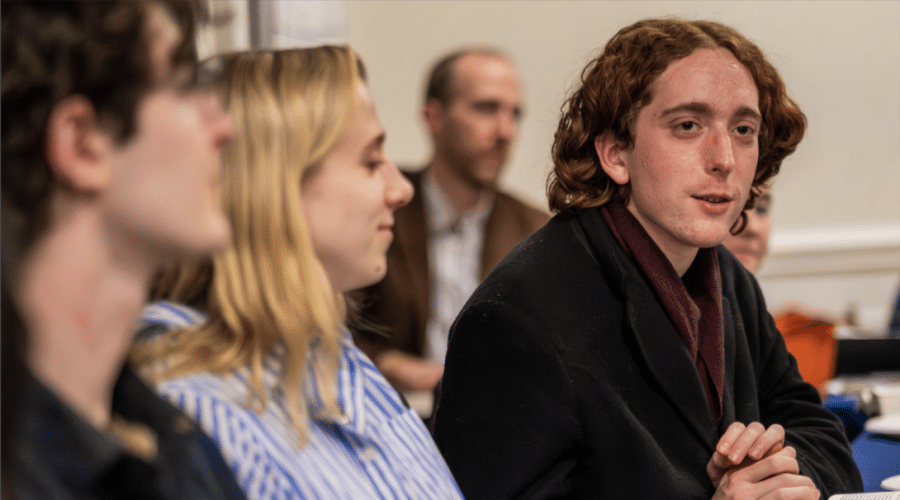
This winter, twenty University of Chicago undergraduates filled Gavin House’s conference room
to discuss the last major work of Hannah Arendt (d. 1975). One of the twentieth century’s most
influential thinkers, Arendt aimed to write a three-part book on thinking, willing, and judging but died
before finishing the final volume.
The impulse to write the book came from attending the trial of Adolf Eichmann in Jerusalem. She
found “no sign in him of firm ideological convictions or of specific evil motives… it was not stupidity
but thoughtlessness” (her emphasis). For Arendt, Eichmann’s “absence of thinking” prompted a
fundamental question: Could the activity of thinking “make men abstain from evil doing or even
‘condition’ them against it?”
For four weeks in January and February, students joined Prof. Magnus Ferguson to discuss Arendt’s thought
provoking work and the ways that it intersects with the Catholic intellectual tradition. Arendt’s doctoral
dissertation explored the work of St. Augustine (Love and Saint Augustine), and she drew upon his work
throughout the rest of her career. Arendt taught at the University of Chicago’s Committee on Social Thought
from 1963 to 1967.
The Arendt reading group was organized by Alex Hu, a Nicklin Fellow at the Lumen Christi Institute. The
purpose of the Nicklin Fellows is to support University of Chicago undergraduate students in the pursuit of
their personal academic and intellectual interests, especially those related to existential questions of being.
The Nicklin Fellowship cultivates robust intellectual friendships rooted in a common love of truth, beauty,
and goodness.