

Miriam enjoys walking the mile to campus from her apartment on 53rd Street. Hyde Park is beautiful in the spring–over the weekend it was overrun by visitors coming to appreciate the cherry blossoms, but this morning as Miriam crosses the quad, she has the cherry blossoms to herself.

Miriam is in the final quarter of her Masters at the University of Chicago Divinity School. This morning, she is on her way to class with Prof. Richard Rosengarten on literary criticism and Christian thought. As Miriam sips her coffee, the class discusses literary theory and the relationship between literature, religion, and language. The theory under examination argues that a culture or individual’s reception of literature depends on what one understands the role of language to be. The class considers how this tension informs Dante’s masterpiece, The Divine Comedy. Rosengarten explains that while in Dante’s time Hebrew was thought to be the ultimate language, Dante himself believed Italian to be the most pure language. At the end of class, Miriam notices that she has half a cup of tepid coffee, smiles and makes a mental note to thank Austin Walker (associate director of Lumen Christi), for recommending the class to her.
On her way to lunch, Miriam runs into her friend Jake, who lives at Ricketts House, Lumen Christi’s student residence. Both lead graduate student reading groups at the Institute, and they chat about how the groups are going. Miriam’s group will meet later that evening to continue working through a compilation of works by Léon Bloy, an early twentieth-century French Catholic writer.
Jake mentions that he recently went to Michael Le Chevallier (senior associate director of Lumen Christi), for career advice and found it very helpful. Miriam laughs, “I also got some really good career advice from Michael!” In fact, she is planning to email Michael after lunch to tell him she got the public policy internship he sent her a few weeks ago.
Later that afternoon, Miriam is at Gavin House for her shift as a student worker. She mostly helps Margaux Taffet (cultural forum coordinator of Lumen Christi) with downtown events and big lectures on campus. Miriam enjoys helping out during events, so that she can extend to more students the same welcoming atmosphere that makes her so at home at Lumen Christi. But she might like the prep work even more, because then she and Margaux can dive into lively discussions about one of their shared passions: conversion literature. While they fold brochures together for an upcoming dinner-lecture, Miriam confides to Margaux that although she is grateful for the opportunity presented by the internship, she still nurses a hope that she will eventually do doctoral work. “I know what I’d work on,” she says. “The history of the philosophical concept of attention from Ignatius of Loyola to Simone Weil.” Austin has already given her a recommendation of a scholar at Duke to reach out to when she begins applying for doctoral programs.
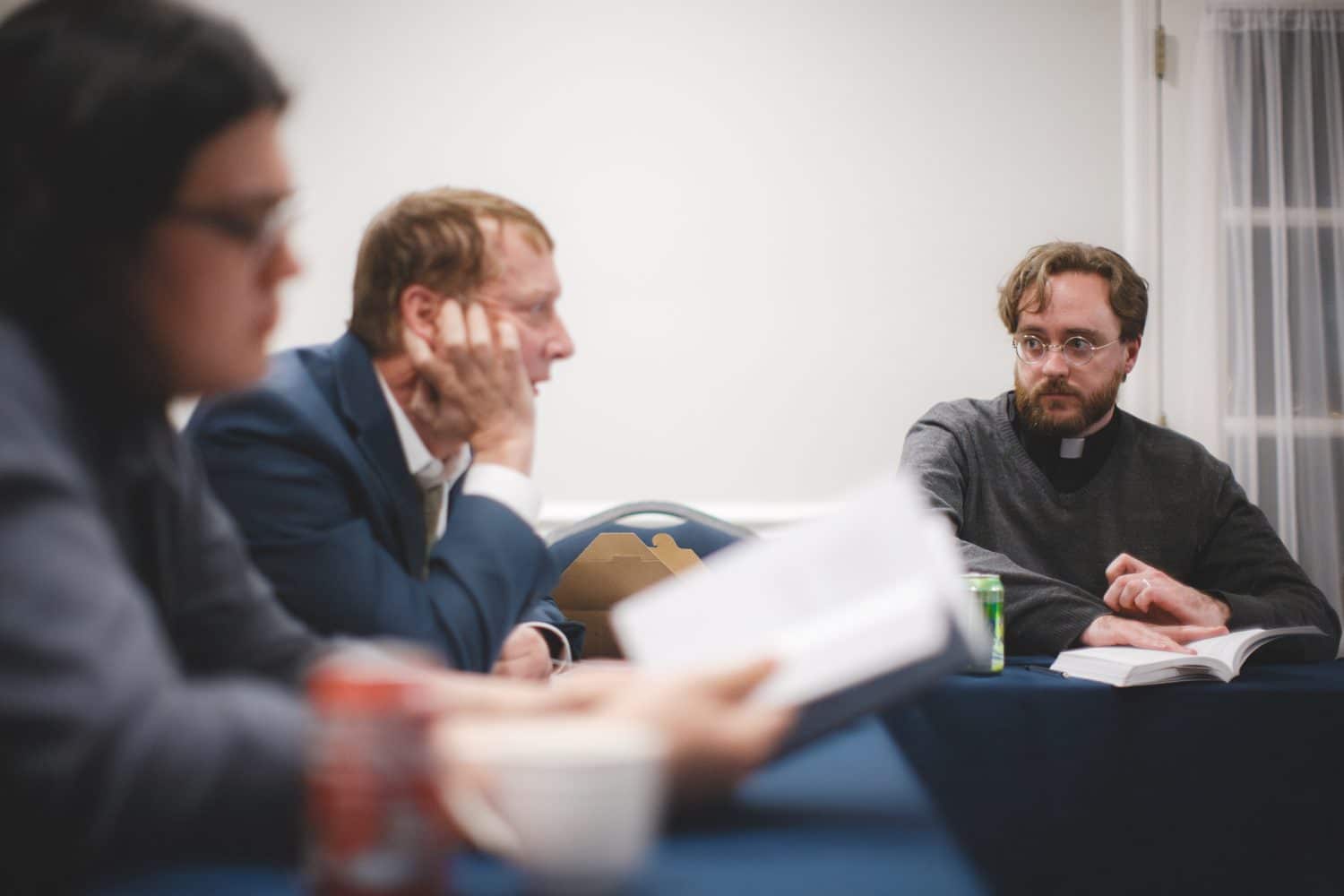
Miriam finishes her day in the Gavin House seminar room. That evening, the group is discussing Bloy’s concept of ‘dolorism.’ Bloy believed that suffering could be mystically substituted. “If you suffer,” Miriam explains, “you can suffer on behalf of someone, and that can help them attain salvation. You can even suffer on behalf of an impious nation.” The group breaks out into a debate about whether God wants us to suffer, with Catholics, other Christians, and self-professed agnostics all joining in.
Someone asks if Bloy should be trusted at all since his penchant for alienating the press meant he could not provide for his children financially. Can you separate the art from the artist? Can we really respect someone and use him as a spiritual leader if he allowed his children to die of starvation?
At nine o’clock, the door to Gavin House closes behind her and Miriam reverses her steps to 53rd Street. She continues to ponder the questions from that evening and marvels how these groups and lectures never fail to attract a substantial number of nonbelievers, many
of whom return again and again.
“One thing that’s really striking about the Lumen Christi events,” Miriam thinks, “is that they never compromise the integrity and the truths of the Catholic faith. People who have no faith background at all are still so drawn to these events and to the people who organize them because of the strength of this conviction. You can sense that there’s something real and true there.”
This is a creative retelling of Miriam’s real experiences as a student at the University of Chicago.