
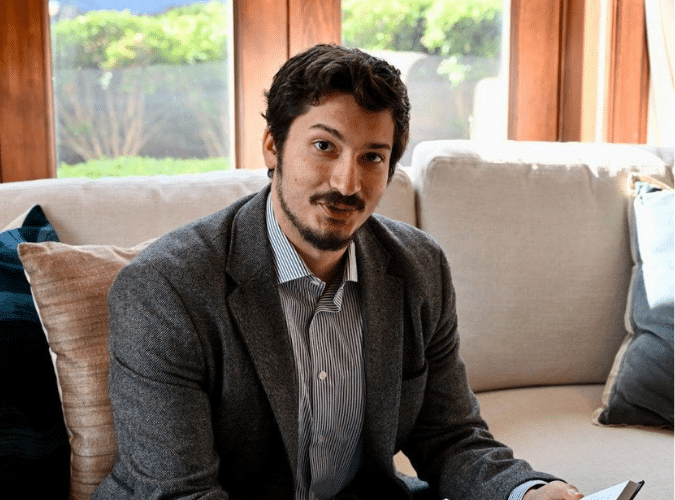
Eric DeVilliers is a Postdoctoral Fellow in Catholic Studies at the Lumen Christi Institute. Dr. DeVilliers (PhD, Notre Dame, 2024) is a Catholic theologian engaged in the comparative study of early Christianity and Islam. His book manuscript explores the meaning and development of the doctrine of the vision of God (visio beatifica). His research demonstrates that there is one continuous discourse from Late Antiquity into early Islam in which the Qur’an accepts and reworks several Christian interpretive themes.
What was your experience with religious dialogue in high school?
My public school felt like a cauldron of different religions. Everyone was pretty enthusiastically religious, even if that was in the form of atheism. People cared deeply about asking the important questions, and that was part of what made me fall in love with my faith and solidified my desire to study theology.
What was your experience as a religious studies major at Yale?
Yale made me realize that there is a big difference between theology and religious studies. Classes on the Bible or the Church fathers were centered less on faith and more on source criticism. I do think there was an attempt to be open to all religious perspectives, but there was a certain sense that the ideas of different faiths ought to be tamed. For example, that the Catholic perspective ought to be socially defined to fit the acceptable standards of the university community.
What was the general student attitude towards faith?
I found that most people were interested, but once the curiosity was assuaged there was nowhere further to go. There was not the same deep yearning I had found so valuable in high school. However, that alienating environment pushed me to engage deeper with those who were driven by their faiths–we shared an alliance through a desire to discuss the most important questions, even if we didn’t always agree.
How did you determine your theological focus at Yale?
After studying in Turkey, I began working extensively with a professor who helped me decide that I wanted to focus on the intersection between the Catholic intellectual tradition and Islam. I recognized that not a lot of work had been done studying this relationship, and I wanted to be part of filling that gap.
What was it like going to Notre Dame?
It was kind of the opposite of Yale. For the first time in my life, I was in a predominantly Catholic environment. Their theology program is very different from religious studies. It was a gift to be around people who shared my faith. However, I think there was a trade off; now the limits were placed on other religious traditions.
What are your long-term career goals?
I want to be a professor who works deeply in the Catholic intellectual tradition. I want my students to know that questions of faith are life determining questions and that there are different perspectives. It is especially valuable to master one and then compare it to another–something that I have done with Catholicism and Islam. That is the ideal way to do theology.
How does Lumen Christi help you realize those goals?
I heard about Lumen Christi while I was at Notre Dame. As the premier organizer of Catholic intellectuals in higher education, I found it deeply compelling. When I completed my PhD, I felt a deep desire for what Lumen Christi provides–a deep grounding in the Catholic intellectual tradition balanced with an enthusiastic engagement with the secular academy. A place that offers grounding and openness is rare, so when I saw that they were offering a postdoc, I knew I had to apply.
What will you do during your time at the Lumen Christi Institute day to day?
Research will be the backbone. I am currently writing a book, comparing the Beatific Vision in early Christianity and early Islam. I am also interested in doing work on the topics of divine transcendence and the analogy between creation and creator. Besides my research, I am here to contribute to the Lumen Christi community as much as I can. I will be part of the team that organizes and invites seminar participants—contributing to the questions and conversations that are posed. I am eager to plug into the traffic of scholars who come through the door, and to integrate myself into the conversations that are being had at the University of Chicago and other universities in the city like Loyola and De Paul. The purpose of life is to force yourself to ask the hard questions, and that is something that Lumen Christi excels at doing.